As the global technology sector pivots from experimental generative AI toward large-scale production deployments, infrastructure providers have become the most scrutinized entities on Wall Street. On January 6, 2026, Penguin Solutions Inc. (NASDAQ: PENG) released its PENG Financial Report for the first quarter of fiscal 2026. The results serve as a litmus test for the company’s ambitious transformation from a legacy memory and hardware manufacturer into a specialized enterprise AI solutions powerhouse.
As of the market close on January 9, 2026, the PENG stock price sits at $19.08, reflecting a complex market reaction to an earnings report that featured a significant bottom-line beat but slightly tempered top-line growth. With a market capitalization hovering around $1.0 billion, Penguin Solutions finds itself in a “valuation gap”—trading at a deep discount to AI peers while showing fundamental operational improvements that suggest the Penguin Solutions stock is primed for a significant re-rating in the coming year.
Dissecting the Q1 2026 Financial Report: Profitability Amidst Strategic Re-Alignment
The PENG Financial Report for the quarter ended November 30, 2025, revealed total net sales of $343.1 million, representing a modest 1% year-over-year increase from $340 million in Q1 2025. While the revenue figure came in slightly below the consensus analyst estimate of $345.1 million, the underlying data suggests a deliberate and healthy shift in the company’s business mix.
The Earnings Beat: Efficiency in Action
The highlight of the Penguin Solutions Earnings was the non-GAAP diluted earnings per share (EPS). The company delivered $0.49 per share, handily surpassing the Wall Street consensus of $0.41. This 20% “beat” was driven by disciplined cost management and a focus on high-margin memory products. On a GAAP basis, the company reported an EPS of $0.04, which was weighed down by stock-based compensation and one-time restructuring charges related to the wind-down of the “Penguin Edge” legacy unit.
The non-GAAP operating income reached $41.5 million, a 1% increase year-over-year, while the non-GAAP operating margin remained steady at 12.1%. This stability is particularly impressive given the macroeconomic headwinds and the company’s decision to walk away from low-margin hyperscale hardware contracts that had previously inflated revenue but diluted profitability.
Inventory and Cash Flow: A Massive Operational Win
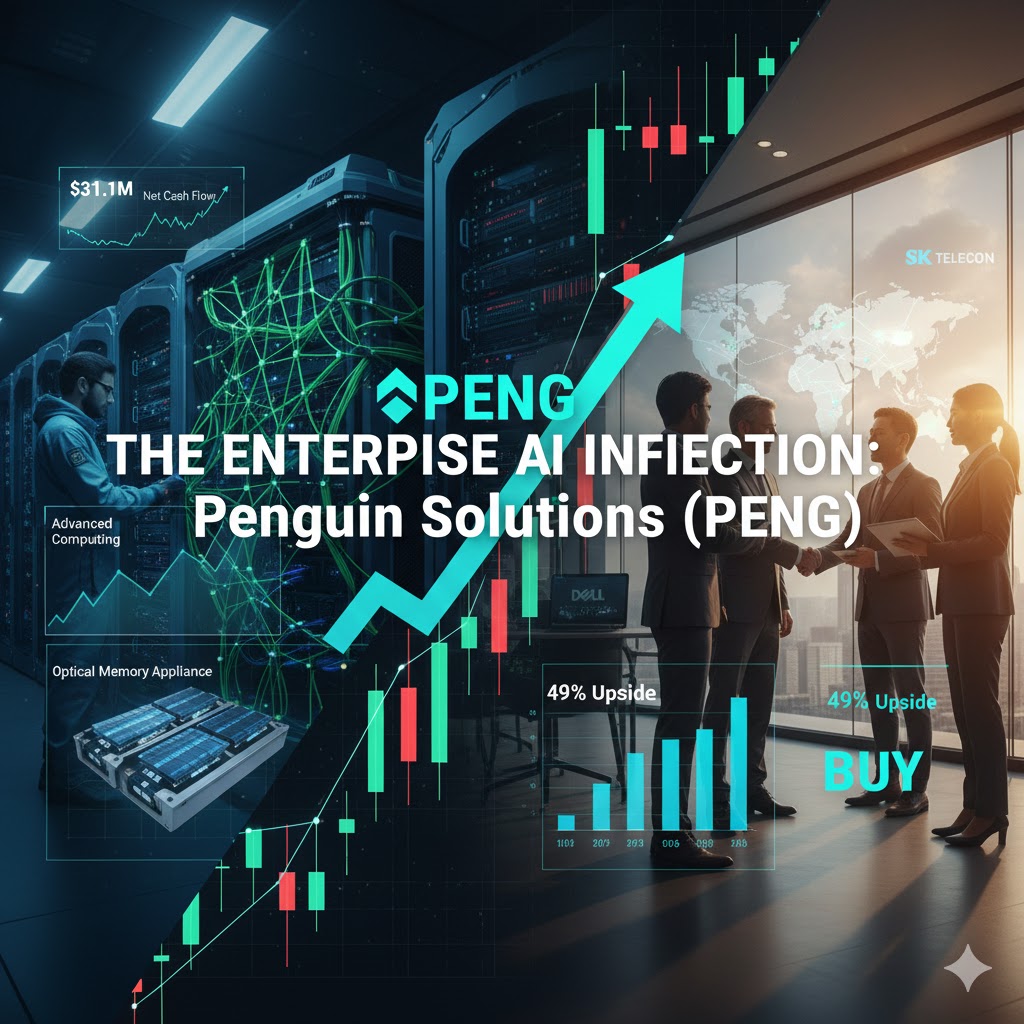
Perhaps the most bullish data point in the PENG stock narrative is the improvement in cash flow. Net cash from operating activities soared to $31.1 million in Q1, compared to a negative $70 million in the previous quarter. This was largely achieved through superior inventory management. Days Inventory Outstanding (DIO) fell from 96 days to 79 days, a clear sign that the company is effectively matching its supply chain to actual customer demand.
Segment Analysis: The Engine Room of Growth
Penguin Solutions’ business is now defined by two distinct growth engines and one legacy stability unit. Understanding the divergence in these segments is key to evaluating the PENG stock price.
Advanced Computing: The Production AI Catalyst
The Advanced Computing segment, which houses the company’s AI infrastructure and high-performance computing (HPC) solutions, generated $151 million in revenue. While this was a 9% sequential increase from Q4, it was lower than the prior year’s Q1 of $177 million.
The decline is primarily attributed to a strategic pivot. Penguin is moving away from selling raw hardware to hyperscalers and toward providing full-stack, “inference-ready” solutions to enterprise clients. These deals are often “lumpier” and take longer to close, but they carry significantly higher margins and include lucrative long-term services contracts. Management confirmed that the pipeline for production AI is the strongest it has ever been, with several “megadeals” expected to close in the second half of fiscal 2026.
Integrated Memory: Surging Demand and High Margins
The Integrated Memory segment was the star of the Penguin Solutions Earnings call, with revenue surging 41% year-over-year to $136.5 million. This segment is benefiting from the “memory wall” in AI—as AI models get larger, they require specialized, low-latency memory that Penguin excels in providing.
The company is currently sampling its next-generation Compute ExpressLink (CXL) and Optical Memory Appliances (OMA). These products are designed to solve the data bottleneck in AI clusters, and initial shipments are slated for late 2026. Analysts expect this segment to grow between 20% and 35% for the full year, providing a powerful tailwind for Penguin Solutions stock.
Optimized LED: A Managed Decline
The LED segment saw revenue drop to $55.1 million from $67 million. This is a non-core, legacy business that Penguin is effectively managing for cash. While it does not excite the “AI growth” investors, it remains a stable source of liquidity.
Strategic Roadmap: The SK Telecom and Dell Partnerships
The long-term value of PENG stock is anchored in two transformative partnerships that were solidified in the months leading up to the 2026 report.
The SK Telecom Alliance
In late 2025, South Korean telecommunications giant SK Telecom completed a $200 million investment in Penguin Solutions. This is far more than a capital injection; it is a strategic partnership aimed at building global AI data centers. By leveraging SK Telecom’s expertise in energy-efficient cooling and Penguin’s ability to design AI infrastructure, the two companies are targeting a multi-billion-dollar market in the Asia-Pacific region.
The Dell “Origin AI” Expansion
Penguin recently announced that its proprietary Origin AI management software will now support Dell Technologies hardware. This move significantly expands Penguin’s Total Addressable Market (TAM). Previously, Penguin’s software was largely locked to its own hardware. By “uncoupling” the software, Penguin can now sell its high-margin AI orchestration tools to any enterprise using Dell servers—which is nearly half of the Fortune 500. This shift toward a software-centric model is expected to drive significant margin expansion starting in mid-2026.
Valuation: Is PENG the Cheapest AI Stock on the Market?
Following the PENG Financial Report, management reaffirmed its full-year 2026 guidance, projecting non-GAAP diluted EPS of $2.00 (±$0.25).
At a PENG stock price of $19.08, the stock is trading at a forward P/E ratio of just 9.5x. To put this in perspective:
- Industry Peer Median: 32x forward P/E
- NVIDIA: 45x forward P/E
- Super Micro Computer: 24x forward P/E
Even with the “lumpiness” of its hardware business, Penguin Solutions stock is trading at a significant discount to its intrinsic value. Most analysts have set a median 12-month price target of $28.50, which represents a 49% upside from current levels.
Conclusion: Investment Verdict and Price Outlook
The Penguin Solutions (PENG) Financial Report issued in January 2026 reveals a company in the middle of a successful “metamorphosis.” By shedding its identity as a commodity hardware player and emerging as an AI infrastructure and software orchestrator, Penguin is building a moat that the market has yet to fully appreciate.
Why Investors Should Care
The bull case for PENG stock is simple: you are buying exposure to the world’s leading enterprise AI infrastructure at a “legacy hardware” price. The company has $461 million in cash, a narrowing debt profile, and a strategic partner in SK Telecom that is one of the most powerful tech players in Asia.
While the revenue growth in Q1 was modest, the “second half of the year” is expected to be significantly stronger as the Dell partnership scales and new memory products hit the market. Management anticipates that 54% of total sales will occur in the back half of the fiscal year.
Final Verdict: BUY
The current PENG stock price of $19.08 is a massive entry opportunity. We believe the market is penalizing the company for its “lumpy” revenue while ignoring the surging profitability of its Integrated Memory segment and the recurring revenue potential of its software suite. As the company hits its $2.00 EPS target by year-end, we expect the stock to re-rate toward the $28–$30 range. For investors seeking a “deep value” play in the AI sector, Penguin Solutions stock is currently the most compelling story in the small-cap semiconductor space.
Leave a Reply