Executive Summary
On January 7, 2026, Albertsons Companies, Inc. — one of the largest grocery and pharmacy retail operators in the United States — released its most recent quarterly results, capturing the market’s attention with its mixed performance metrics amid broader retail and economic uncertainties. The ACI Financial Report for the third quarter of fiscal 2025 showed modest year-over-year sales growth that met analyst expectations, driven by stronger pharmacy and digital sales, but with net income and profitability under pressure due to narrow margins and elevated operating costs. The headline numbers included revenue of approximately $19.1 billion, adjusted EPS that beat consensus, and a net income figure reflecting both growth and cost challenges.
The market reacted with volatility: shares of ACI stock fell sharply post-earnings, suggesting that investors were cautious or disappointed by specific guidance, margin trends, or expenses. The ACI stock price, trading near a one-year low vs. its highs, reflects both macro headwinds and company-specific risks.
This report delivers a professional, detailed analysis of the latest earnings, including:
- Dissection of revenue growth drivers (identical store sales, digital, pharmacy)
- Profit margin trends and cost structure implications
- Balance sheet and cash flow analysis
- Strategic initiatives such as online expansion and digital platforms
- Competitive positioning relative to peers
- Forward-looking outlook for revenue, profitability, and stock valuation
- A comprehensive investment recommendation
Throughout the report, the metrics and narrative provide a sophisticated view of how Albertsons is managing structural industry challenges, navigating consumer demand shifts, and positioning itself for future growth.
Keywords included: ACI stock, Albertsons Companies stock, ACI stock price, ACI Financial Report, Albertsons Companies Earnings.
Industry & Competitive Context
Albertsons operates in an industry defined by razor-thin margins, intense competition, supply chain constraints, and changing consumer behaviors. Grocery retail is both recession-resilient — with food and pharmacy products considered essential — and highly capital-intensive, as retailers must constantly balance pricing, inventory, labor costs, and technological investments to retain customers and protect margins.
Competitors such as Kroger, Walmart’s grocery operations, Costco, Target, and regional chains like Publix and Aldi pressure Albertsons on pricing, store experience, and convenience services. The retail sector overall has seen accelerating digital penetration, with online grocery ordering and delivery services becoming key battlegrounds — costs for which often compress profitability even as they drive incremental top-line growth.
The context for the most recent quarter included ongoing macroeconomic pressure on consumer budgets, with food and grocery inflation gradually stabilizing but still above historical norms, affecting spending patterns and basket sizes. The sector’s capital intensity and reliance on efficient logistics challenge margins, and companies like Albertsons have responded with investments in digital, pharmacy, loyalty programs, and fulfillment technologies.
Latest Earnings Overview (January 7, 2026)
Albertsons reported its Q3 fiscal 2025 earnings on January 7, 2026, with the following key figures and trends:
- Net revenue/Net sales: Approximately $19.1 billion, up modestly year-over-year and effectively in line with analyst expectations.
- Adjusted EPS: Approximately $0.72 per share, exceeding consensus estimates (~$0.67), signaling operational resilience at the profit level.
- Net income: Reflecting moderate profitability and growth from core operations, but with narrower margins compared with broader revenue growth.
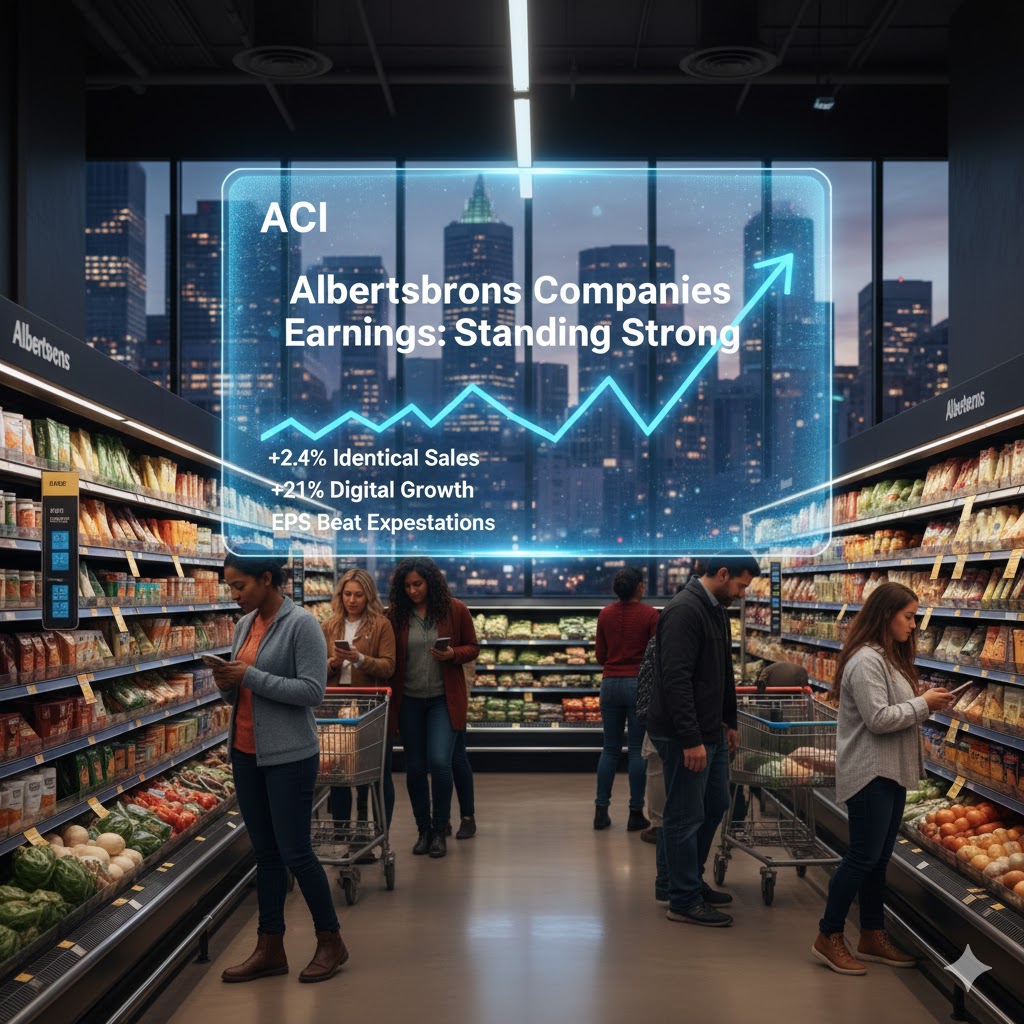
- Identical/Comparable store sales: Increased by roughly 2.4%, driven by higher pharmacy and fresh food sales, and a notably strong 21% surge in digital sales.
- Digital sales growth was partially offset by lower fuel revenue and the effect of store closures relative to the prior year.
- Adjusted EBITDA was solid, though margins remained tight.
Although revenue growth was modest at ~1.9% with same-store sales up 2.4%, the digital business’s 21% expansion illustrates a significant shift in consumer behavior toward online and omnichannel fulfillment.
However, the reaction from ACI’s share price was negative, with a share drop of approximately 7.6% reported shortly after the earnings release — reflecting investor concerns over margins, full-year guidance, and profitability sustainability.
Revenue and Sales Dynamics
Total Revenue Growth
Albertsons’ revenue performance — up around 1.9% year-over-year — reflects a compelling blend of resilience and pressure. Grocery sales continue to draw consistent customer demand even amid macro cost pressures, but the real story lies in product category shifts:
- Pharmacy sales were a standout driver of growth, supported by increased prescription volume and expanded health services. Pharmacy typically carries higher margins than grocery items, which helped dampen the impact of compressed grocery margins.
- Fresh food and perishable categories also contributed meaningfully, as consumers increasingly seek convenience and quality in these segments.
- Digital and omnichannel fulfillment: Albertsons reported a 21% increase in digital sales, signaling successful investment in e-commerce, click-and-collect, and delivery services.
In food retail, same-store sales increases — which measure comparable transactions excluding store openings/closures — are often considered a high-quality indicator of organic demand strength. A ~2.4% increase suggests the company is retaining or growing customer loyalty, once adjustments for fuel and store closures are factored in.
Fuel Sales and Store Closure Effects
Despite positive contributions from core retail formats and digital channels, lower fuel sales and the net impact of store closures or rationalizations since the prior year partially offset gains in other areas.
Fuel margins tend to be volatile but historically have contributed meaningful ancillary revenue for large grocery chains. The decline here is likely tied to lower gasoline prices year-over-year and reduced profit per gallon. Even when fuel transaction volumes remain stable, the per-unit margin impact can ripple through reported net sales.
Store closures, while sometimes strategically necessary to eliminate underperforming locations, reduce total sales volume and require careful offset with productivity improvements elsewhere in the chain.
Profitability and Margins Analysis
Although revenue growth was modestly positive, profitability metrics show a more nuanced picture:
- Net margin: Reported at roughly 1.20%, indicating a very thin profit layer across total sales.
- Return on equity (ROE): A noteworthy 36.39%, suggesting strong capital effectiveness relative to net earnings.
- Adjusted EBITDA margin: Healthy for the sector, but reflecting modest incremental improvements.
A net margin at or around 1% is typical for large supermarket chains, where gross margins are subdued by competitive pricing and the cost structures of perishable inventory, freight, labor, and in-store operations. For context, this margin level compares with industry peers — albeit at the lower end of profitable performance bands — because grocery retail historically trades off margin for volume. Indeed, many competitors operate in the same single-digit net margin environment.
However, analysts and investors pay close attention to operating margins, gross margins, and EBITDA margins because they help capture operational efficiency beyond raw net margin calculations. In this quarter:
- Adjusted EBITDA and gross margins held relatively steady, suggesting that operational control initiatives — such as cost efficiencies, supply chain management, pricing optimization, and shrink reduction — continue to have effect.
Despite low absolute net margin, the improved or stable mid-level profitability metrics reveal that Albertsons can absorb modest revenue changes without proportional earnings declines — a competitive advantage in a low-growth environment.
Cost Structure and Expense Drivers
Key drivers of expense growth typically revolve around:
- Labor costs: With rising wages and benefits, especially for frontline workers in grocery and pharmacy, labor constitutes a large share of operating expenses. Grocery margins are especially sensitive to wage inflation because labor represents ~20–30% of typical operating costs.
- Supply chain and logistics costs: Freight inflation, handling/warehouse costs, and spoilage risk in perishables can increase overhead and squeeze margin.
- Technology and digital platform investments: While digital sales provide future growth potential, the initial rollout, maintenance, delivery partnerships, and fulfillment systems generate upfront expenses.
The January 7 earnings reflect these pressures implicitly. Analysts often point to rising selling, general & administrative (SG&A) costs and investments in digital and pharmacy growth platforms as contributors to mid-term expenditure increases. These investments are critical for long-run competitive positioning even as they restrain short-run earnings growth.
Digital Sales and Omnichannel Strategy
One of the standout results in the earnings was the 21% increase in digital and online sales, far outpacing brick-and-mortar revenue growth.
This trend aligns with broader retail shifts toward omnichannel consumption. Grocery consumers increasingly combine in-store shopping with online ordering, curbside pickup, and home delivery. Grocery retail historically lagged other retail sectors in digital adoption due to the complexity of fulfilling perishable goods efficiently; however, the pandemic accelerated online grocery engagement, and sustained digital behavior suggests this trend is no longer a short-term phenomenon.
Strategic digital initiatives that likely contributed include:
- Improved mobile app and loyalty integration: Loyalty programs help tailor promotions and increase frequency of purchases, improving both digital conversion and basket size.
- Partnerships with third-party delivery platforms: While delivery can be costly, expanding reach through partners allows incremental revenue capture.
- In-house fulfillment optimization: Enhanced order routing, store fulfillment systems, and inventory visibility improve delivery speed and item availability — key drivers of repeat digital customer behavior.
The continued strength of digital sales supports Albertsons’ omnichannel growth model, which in turn could drive higher lifetime customer value. While digital fulfillment often carries lower margins, higher basket size and repeat purchase rates can offset these costs over the long term.
Pharmacy Segment Performance and Strategic Importance
Pharmacy performance was another notable contributor to revenue growth in the quarter. Pharmaceuticals typically carry higher gross margins than food and beverages, and increased prescription volume can be a stable and predictable revenue stream — particularly for aging populations.
Key strategic drivers for pharmacy growth include:
- Expanded clinical services: Immunizations, health screenings, and medication adherence programs create ancillary revenue and deepen customer engagement.
- Insurance partnerships: Favorable arrangements with insurance providers can increase prescription fulfillment at Albertsons-owned pharmacies.
Given pharmacy’s relative margin advantage, incremental growth here materially contributes to overall profit even if total sales volume growth is modest. An increased pharmacy mix in total sales suggests improved revenue quality.
Balance Sheet and Cash Flow Dynamics
According to aggregated financial statistics, Albertsons Companies’ balance sheet reflects ongoing investment alongside conservative operational cash flow generation:
- Market capitalization: Approximately $8.84 billion, reflecting a contraction from prior periods but still a substantial presence in U.S. retail.
- Trailing P/E ratio: Around 10.71, indicating a valuation that may be considered low relative to general market multiples and suggesting potential undervaluation or risk discounting.
- Debt position: Significant long-term debt (~$15.4 billion) with modest cash on hand (~$208.7 million), resulting in a net leveraged position.
- Operating cash flow: Strong at ~$2.41 billion, with free cash flow of ~$510 million, demonstrating solid cash conversion from operations.
The leverage profile, while high, is not unusual among large supermarket chains that optimize capital structure through some borrowing — particularly in capital-intensive retail environments. Debt refinancings and cost of capital considerations remain important.
Albertsons also pays a dividend with a yield above 3%, offering income appeal to certain investor segments.
Strategic Initiatives and Long-Term Growth Drivers
Albertsons Strategies moving forward include:
1. Expansion of Omnichannel and Digital Services:
The 21% digital sales growth underscores the importance of mobile apps, delivery partnerships, and online loyalty programs for future revenue expansion. Digital customer engagement can drive repeat purchases and improve lifetime value.
2. Pharmacy Growth and Health-Focused Services:
Pharmacy represents a higher margin business line. Expanding clinical services, insurance partnerships, and patient care programs can elevate profitability relative to core grocery sales.
3. Cost Structure Optimization:
Operational efficiencies — inventory management, reduction in shrink, automation in distribution centers, and labor scheduling — can improve margins even as gross sales grow modestly.
4. Store Remodelling and Format Innovation:
Optimizing store footprints with express lanes, micro-fulfillment centers, and targeted product assortments responds to evolving consumer preferences.
5. Loyalty and Data Analytics:
Enhanced loyalty platforms allow for targeted promotions, personalized offerings, and better inventory planning based on consumer data.
Each of these strategic pillars directly influences future revenue and profit prospects and requires sustained investment with appropriate ROI monitoring.
Competitive Positioning and Market Share
Albertsons remains one of the top grocery retail players in the U.S., trailing larger operators like Kroger and Walmart Grocery but competing effectively in regional markets and specific demographic segments. Its portfolio includes well-known banners such as Safeway, Vons, Jewel-Osco, and others — enabling diverse regional penetration.
Competitive pressures include discount rivals such as Aldi and Lidl, which emphasize low prices at the cost of narrower assortments. Price competition compresses margins for full-service supermarkets, but differentiated services (pharmacy, online fulfillment, loyalty benefits) help defend market share.
Albertsons’ strategy of integrating digital and pharmacy services alongside traditional grocery retail makes it better positioned to capture higher-value customer segments willing to trade convenience and service for price.
Market & Consumer Behavior Trends
Shifting consumer behaviors — including greater demand for online ordering, delivery, and contactless pickup — have persisted post-pandemic. Grocery retailers that adapt quickly gain competitive advantage. Albertsons’ 21% digital growth suggests it is aligning with these trends.
However, macroeconomic headwinds such as inflation, wage pressures, and reduced discretionary spending continue to constrain average transaction size and frequency. Though grocery is essential, consumers still trade down or switch brands to manage budgets — a dynamic that compresses margin for branded items but sometimes benefits private label sales.
Private label product lines historically deliver higher gross margins; strategic emphasis on store brands may further elevate profitability as consumer acceptance grows.
Stock Valuation and Investor Reception
Following the January 7, 2026 earnings release, the ACI stock price pulled back significantly — a typical market reaction when guidance is viewed as cautious or when margin pressures overshadow revenue beats.
Trading near the lower end of its year range, and with a forward P/E ratio below 8, the equity appears to carry a valuation discount relative to broader retail peers.
Investors wary of grocery retail’s structural cost pressures and debt leverage demand higher return prospects. On the other hand, a valuation close to historical lows and an above-3% dividend yield may attract value-oriented investors.
Risks and Headwinds
Key risks include:
- Margin pressure from competition and operating costs
- Debt servicing costs and interest rate exposure
- Slower-than-expected digital monetization
- Macro factors impacting consumer spending
While essential goods support baseline demand, sales growth and margin expansion remain challenging.
Investment Recommendation & Outlook
Given the analysis:
- Valuation Remains Attractive: Low P/E and modest share price relative to historical ranges suggest potential upside if margin initiatives succeed.
- Dividend Provides Income Cushion: A ~3% dividend yield supports total return.
- Digital Adoption Offers Long-Term Growth: Sustained digital sales growth positions Albertsons for future revenue diversification.
Recommendation: Buy (Medium- to Long-Term Focus)
Investors with a multi-year horizon may find value in ACI’s combination of essential retail demand, digital and pharmacy growth catalysts, and valuation discount. Risk-focused investors may prefer to await clearer margin expansion signals or further cost efficiency outcomes.
Conclusion
The Albertsons Companies Earnings for the quarter ending in late 2025, as reported on January 7, 2026 in the ACI Financial Report, reflect a company navigating the complexities of modern grocery retail with a diversified strategy that includes strong digital growth, pharmacy revenue gains, and focus on operational resilience. While short-term profit margins remain tight and investor reaction has been cautious, long-term strategic positioning and valuation appeal create an opportunity for disciplined investors. The ACI stock price, currently under pressure relative to historical levels, could offer value as strategic initiatives begin to deliver margin expansion and stronger profitability signals.
Leave a Reply